
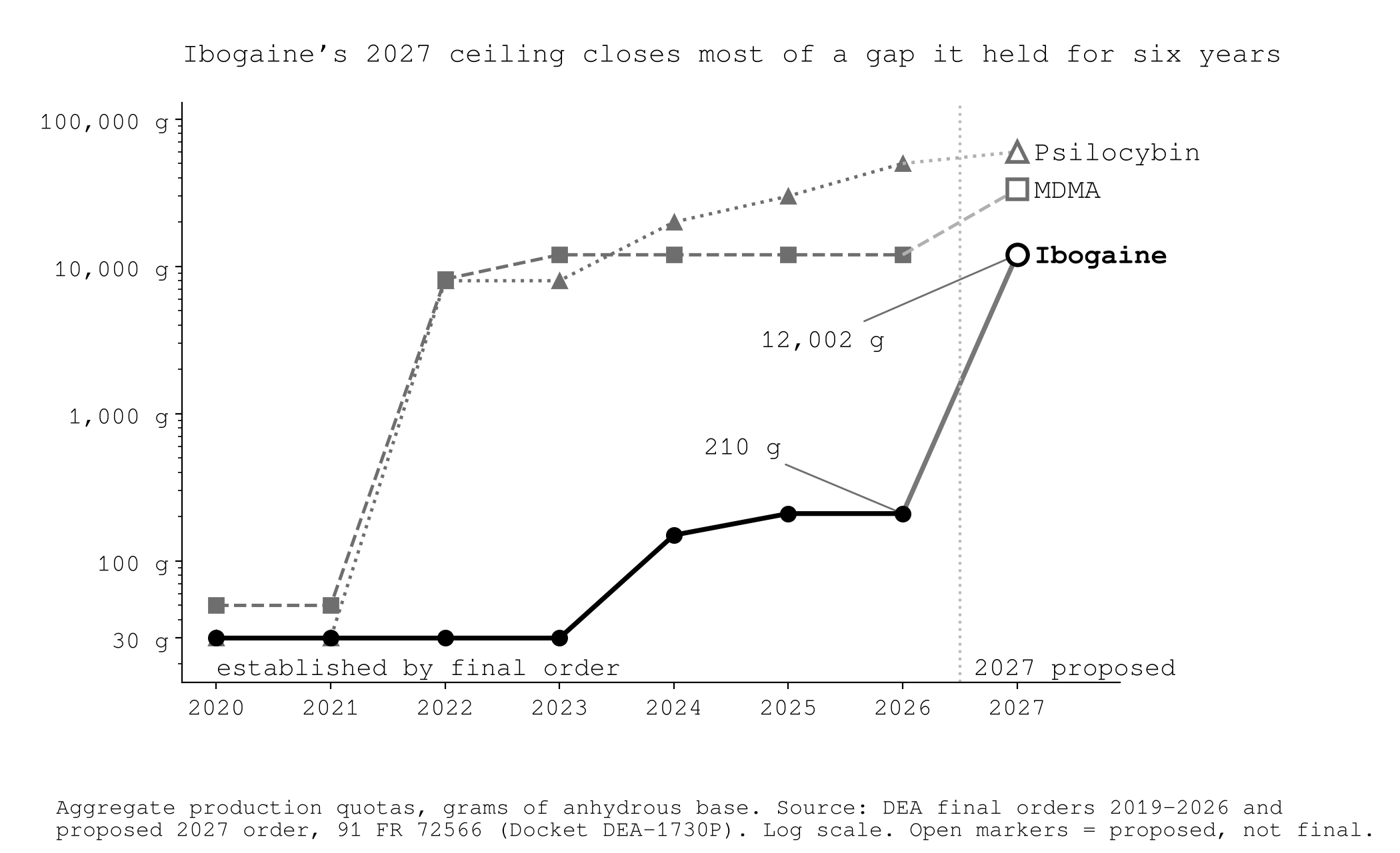
A production quota is a receipt. On November 10, 2026, the Drug Enforcement Administration published its proposed 2027 aggregate production quotas (APQs) and set ibogaine at 12,002 grams, against 210 grams established for 2026 (DEA, 2026a, 2026h). That is 57 times the current ceiling, and it is the largest multiple anywhere in the 2027 table. The next largest is 6.25.
The number matters less for what DEA thinks about ibogaine than for what it reveals about who has been filing paperwork. The figure is built largely from what registered companies asked for, on forms that require them to state quantity and purpose, months before the notice appeared (21 CFR 1303.11). An agency’s label tells you what it believes. A quota line tells you what somebody intends to make. The quota is proposed, not final, and comments close December 10, 2026 (DEA, 2026h).
1. The Number and Its History
Ibogaine sat at 30 grams for six consecutive quota years, established at that level for 2018 through 2023 (DEA, 2017, 2018, 2019, 2020, 2021, 2022). In October 2023, DEA proposed adjusting the 2023 figure upward to 150 grams (DEA, 2023). No final adjusted order carrying that change was published. The 150 gram figure instead took effect through the established order for 2024 (DEA, 2024a). DEA's final adjusted order of December 17, 2024 left the 2024 ibogaine quota at 150 grams, so the 2024 revision did not raise it (DEA, 2024b). The 210 gram level first appears as an established figure in the 2025 order, published the same day (DEA, 2024c), and was carried into 2026 unchanged (DEA, 2026a).
For six years the quota sat at 30 grams. It rose to 150 in 2024 and 210 in 2025, where it stays for 2026. The 2027 proposal is 12,002 grams, about 57 times the current level.
DEA's stated reason, verbatim: "DEA is proposing higher APQs than the 2026 proposed revised APQs for the following schedule I controlled substances: 3,4-Methylenedioxymethamphetamine (MDMA) and ibogaine to support manufacturing activities related to the increased level of research and clinical trials being conducted with these substances for potential treatment of conditions including post-traumatic stress disorder (PTSD) and depression" (DEA, 2026h). The notice attributes the increase to alignment with two executive orders, E.O. 14379 and E.O. 14401 (DEA, 2026h; Exec. Order No. 14379, 2026; Exec. Order No. 14401, 2026). MDMA moves from 12,000 grams to 33,296 in the same table (DEA, 2026a, 2026h).
One construction detail is worth naming and then leaving alone. The figure is 12,002, not 12,000. An odd two grams reads to me like the residue of a sum rather than a round number chosen for effect. That is my inference, not a finding, and nothing below rests on it.
2. How the Number Gets Built
An aggregate production quota establishes the total quantity of a schedule I or II class that may be produced by all manufacturers in a calendar year (21 CFR 1303.03(a)). The Administrator sets it at the quantity necessary to be manufactured for the estimated medical, scientific, research, and industrial needs of the United States, for lawful export requirements, and for the establishment and maintenance of reserve stocks (21 CFR 1303.11).
Seven factors govern that determination (21 CFR 1303.11). Six are the agency's own estimates: net disposal over three years, trends in net disposal, inventories, the extent of diversion, information from the Department of Health and Human Services (HHS) and the states, and a residual category covering raw material availability, yield, and stability. The fourth is different. It is "[p]rojected demand for such class as indicated by procurement quotas requested" (21 CFR 1303.11), a tally of filings rather than an estimate.
The filings have deadlines. A manufacturer wanting to use a schedule I class next year applies for a procurement quota on DEA Form 250, due on or before April 1 of the preceding year (21 CFR 1303.15(b)). A registered bulk manufacturer wanting to make it applies for a manufacturing quota on DEA Form 189, due on or before May 1 of the preceding year (21 CFR 1303.22). The 2027 figure therefore reflects paperwork that was substantially complete by spring 2026, roughly six months before the notice.
This is why the number is informative in a way a designation is not. Twelve kilograms did not appear because DEA formed a view about ibogaine. It appeared, at least in part, because registrants filed applications stating quantities, and they face consequences for what they put on those forms.
Two limits keep the reading honest. DEA does not publish the applications, so the split between requested quantities and the agency's own estimate of research need is not on the record. And the quota is permission, not activity. It is a receipt for requests, not a receipt for production.
3. Who Is Lining Up
First, the scope. The proposed quotas "represent those quantities of schedule I and II controlled substances ... to be manufactured in the United States in 2027," and they exclude imports of controlled substances (DEA, 2026h). The regulation makes the relationship explicit from the other direction: in deciding whether to adjust an aggregate quota, DEA considers whether increased demand can be met through existing inventories, increased individual manufacturing quotas, or increased importation, "without increasing the aggregate production quota" (21 CFR 1303.13(b)(3)). Imported ibogaine does not consume the 12,002 grams. It is the alternative to it.
That makes the registration record the place to look. From the Federal Register, with no inference about intent:
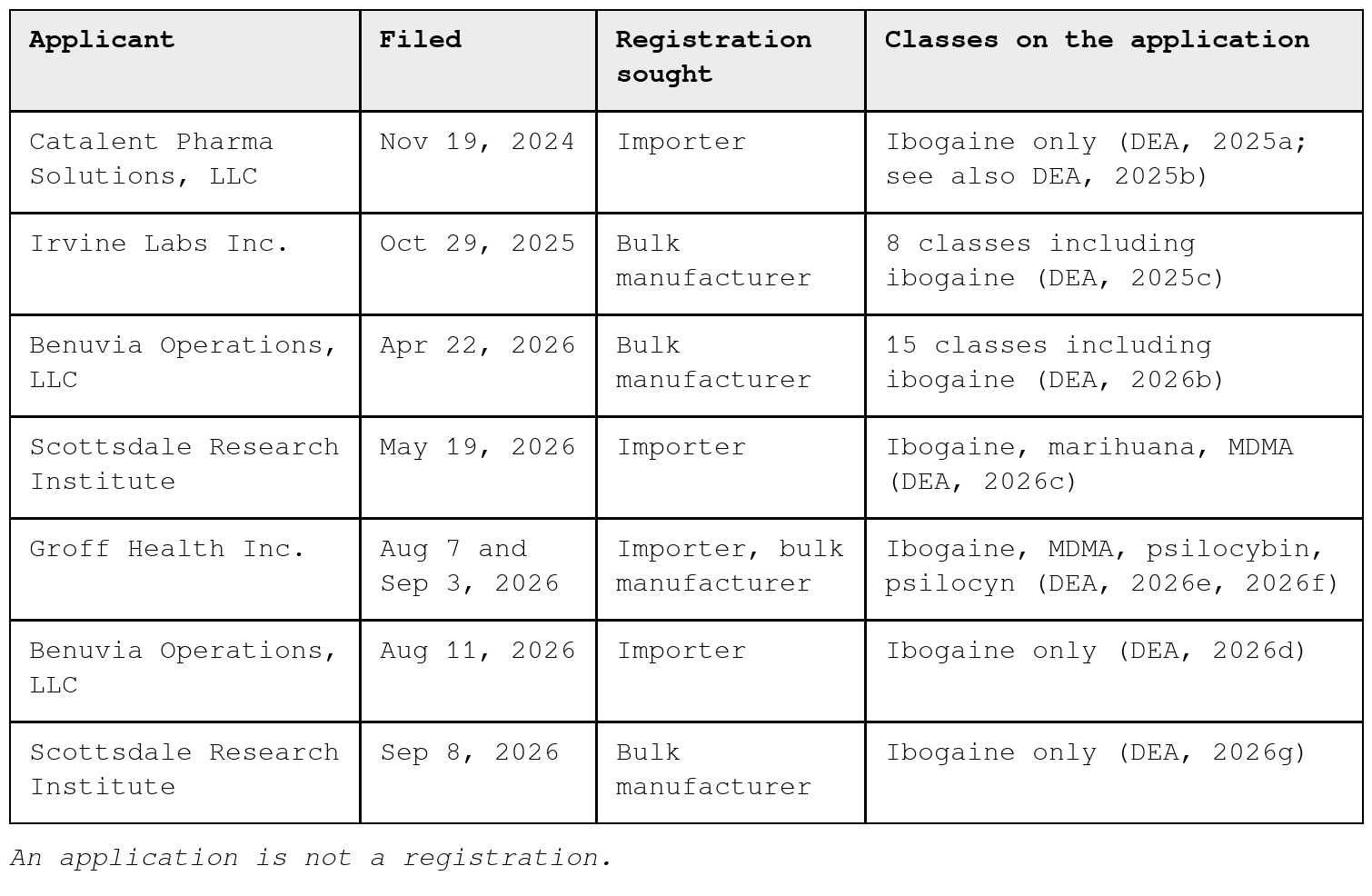
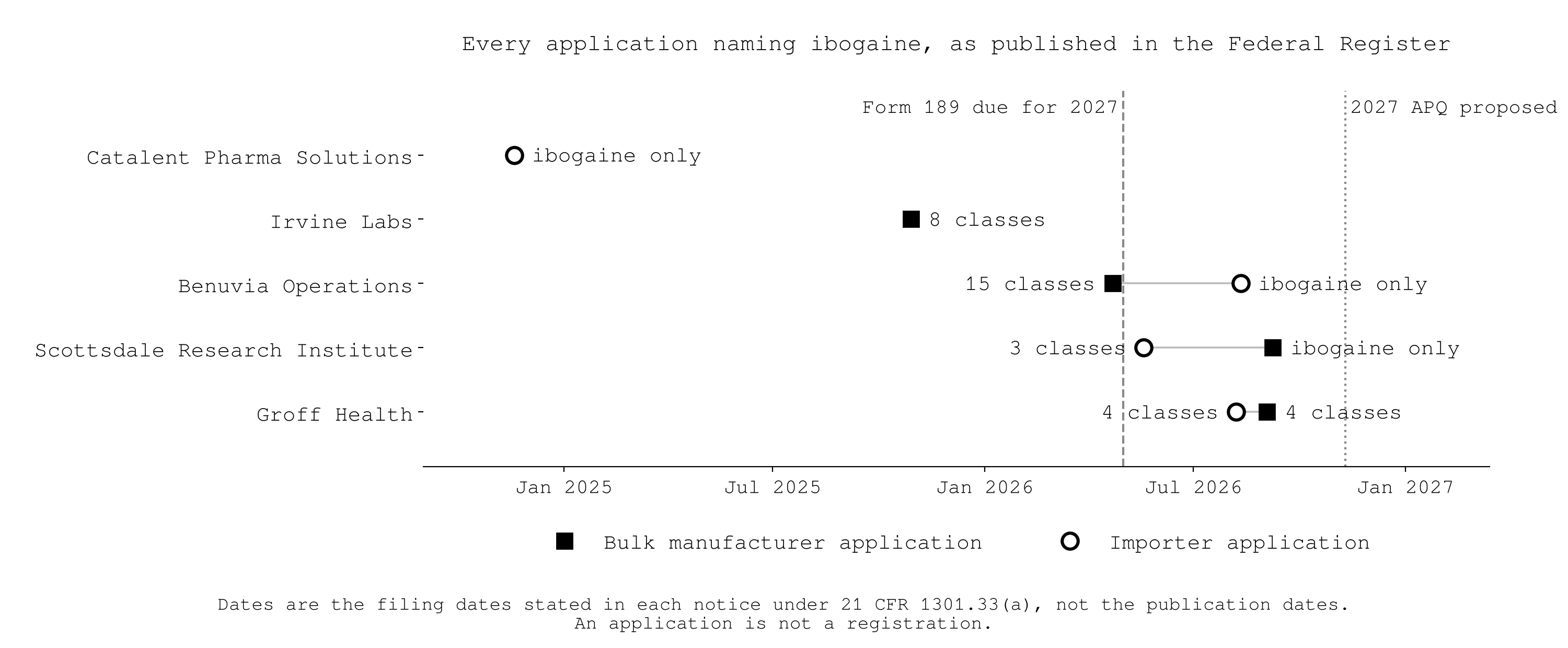
Separately, Psyence Biomedical announced on October 5, 2026 that its Texas subsidiary had engaged Benuvia Operations to manufacture ibogaine, and reported that Benuvia holds roughly half of the current United States aggregate quota and is advancing an import permit application and a procurement quota application. Psyence stated that the information about Benuvia came from Benuvia and had not been independently verified (Psyence Biomedical, 2026). DEA does not publish individual manufacturing quotas, so that share cannot be checked against the record. Treat it as a company statement.
Beneath the import question sits a supply question the regulation names directly. Among the residual factors DEA weighs is "the economic and physical availability of raw materials for use in manufacturing" (21 CFR 1303.11). Twelve kilograms is a different procurement problem from 210 grams, and the quota does not say whether it has been solved.
4. What the Grams Buy
DEA expresses the quota "in grams of anhydrous acid or base" (DEA, 2026h). So 12,002 grams is ibogaine base. Clinical material is generally the hydrochloride, and ibogaine hydrochloride is 346.9 grams per mole against 310.4 for the base, so a gram of the salt carries 0.895 grams of base.
The Food and Drug Administration (FDA) sketched the dosing in its October 2026 request for information: initial trials could use sequential ascending groups "starting with an initial dose justified by the published literature and not exceeding 10 mg/kg," and it noted that "[d]oses ranging from 5 to 20 mg/kg have been described in published clinical reports" without adequate safety margins (FDA, 2026). FDA also asked whether dosing should be based on total body weight, lean body weight, or a target exposure, so the denominator is itself unsettled (FDA, 2026).
Assumptions, stated: 70 and 90 kilograms of body weight; doses of 5, 10, and 20 mg/kg; the dose expressed either as hydrochloride or as base, since the RFI does not specify. On that grid, 210 grams is 116 to 670 adult administrations and 12,002 grams is 6,667 to 38,323. At FDA's 10 mg/kg ceiling, 233 to 335 and 13,335 to 19,161.
The full grid is in ibogaine_dose_arithmetic.csv. Those are gross figures. Material comes off the top before anyone is dosed. The regulation allows a manufacturer an inventory equal to 40 percent of estimated net disposal as part of its quota (21 CFR 1303.24(a)), so about 29 percent of a quota built that way is reserve. Reference standards, release and stability testing, non-clinical toxicology, and conversion losses come off what remains, and DEA publishes none of that split. Deducting the 40 percent allowance and a 10 to 30 percent loss, at the 10 mg/kg ceiling, leaves roughly 116 to 215 administrations from 210 grams and roughly 6,700 to 12,300 from 12,002.
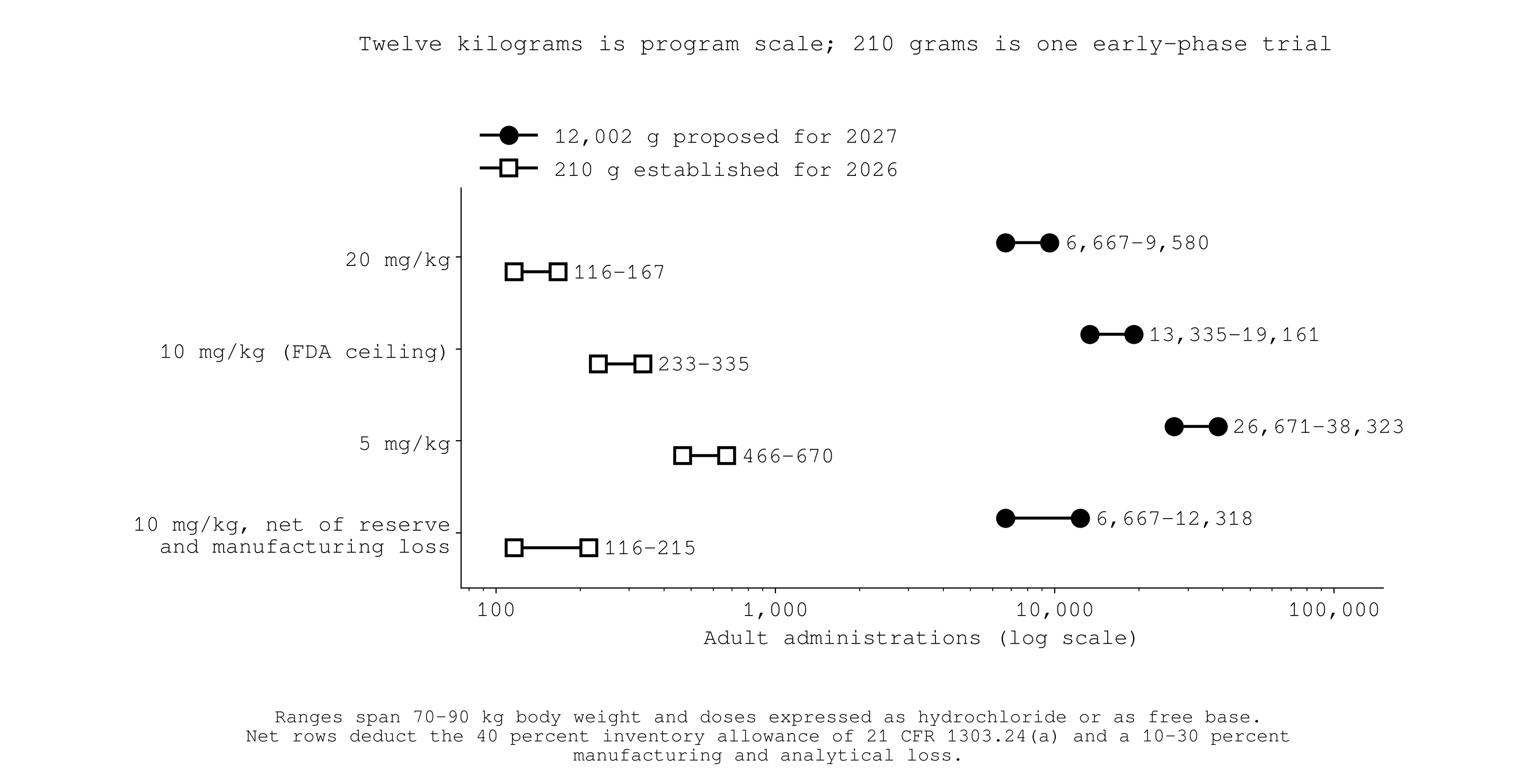
Read plainly: 210 grams is the material for one early-phase program and its analytical support. Twelve kilograms is the material for several programs running at once, with stability lots and reserve stock behind them.
5. What This Is Not
It is not final. It is a proposal under 21 U.S.C. 826, open for comment until December 10, 2026, and DEA may hold a hearing on issues the comments raise (DEA, 2026h; 21 CFR 1303.11).
It is not demand realized. A quota is a ceiling. Nobody is obliged to manufacture 12,002 grams, and the trials to consume it have to exist.
It is not a scheduling action. Ibogaine remains in schedule I, which is the premise of having a quota at all.
It is not a safety or efficacy finding. FDA has identified serious risks with ibogaine drug products, including QTc prolongation and associated arrhythmia risk, non-clinical neurotoxicity, and uncertainty about an appropriate human starting dose (FDA, 2026).
Right to Try needs more care than a flat denial. E.O. 14401, which DEA cites, directs FDA and DEA to "facilitate and establish a pathway for eligible patients to access psychedelic drugs, including ibogaine compounds, under the Right to Try Act," including necessary schedule I handling authorizations (Exec. Order No. 14401, 2026). Right to Try is inside the stated rationale. The quota is not that pathway. It authorizes manufacture and says nothing about who may receive the product.
On indications, DEA's sentence names PTSD and depression (DEA, 2026h). FDA's RFI says the first federally supported trials are expected in adults with opioid use disorder and adults with PTSD, that the National Institute on Drug Abuse (NIDA) is funding ibogaine research for opioid use disorder, and that the Advanced Research Projects Agency for Health (ARPA-H) is funding early-phase trials (FDA, 2026). PTSD appears on both sides. Depression does not appear in FDA's description of the federally funded work. And E.O. 14379, the addiction order DEA cites, mentions neither ibogaine, nor psychedelics, nor production quotas (Exec. Order No. 14379, 2026).
6. What the Record Will Show Next
Four things will test the receipt reading. The established order, which in the seven most recent cycles followed the proposal by 38 to 90 days, will show whether 12,002 survives comment. Individual manufacturing quotas are fixed by December 1 each year but are not published (21 CFR 1303.21(a)), so that half stays dark. DEA's action on the pending applications will be published. Import permits are issued per shipment and will not be.
If the receipt reading is right, the final figure should land at or near 12,002 and at least one new ibogaine bulk manufacturer registration should issue. If DEA cuts the figure materially and explains the cut in terms of its own estimate of research need rather than requests received, the reading was too narrow, and factor four was carrying less of the number than I have assumed.
A quota is still a receipt. It tells you that parties with registrations and something to lose asked for twelve kilograms of a schedule I alkaloid and told DEA what they meant to do with it. It does not tell you that the material will be made, that the trials will enroll, or that anyone will be treated. Those are separate records, and they are not written yet.
Sidebar: The Calendar
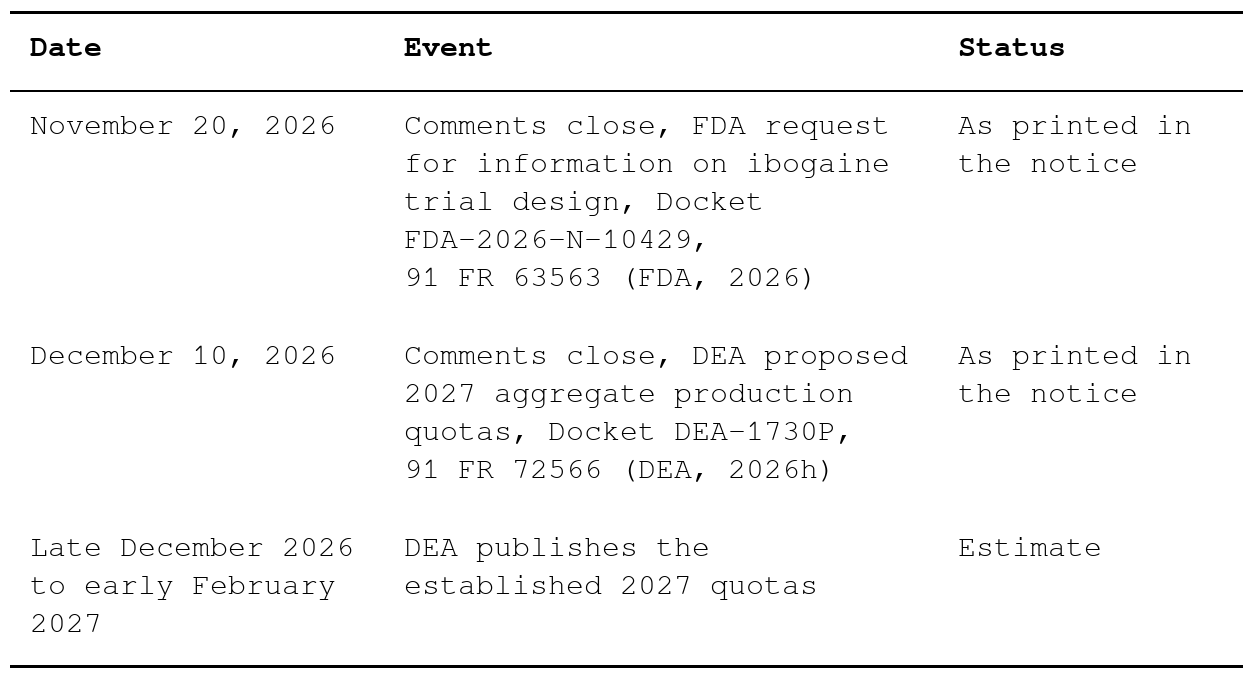
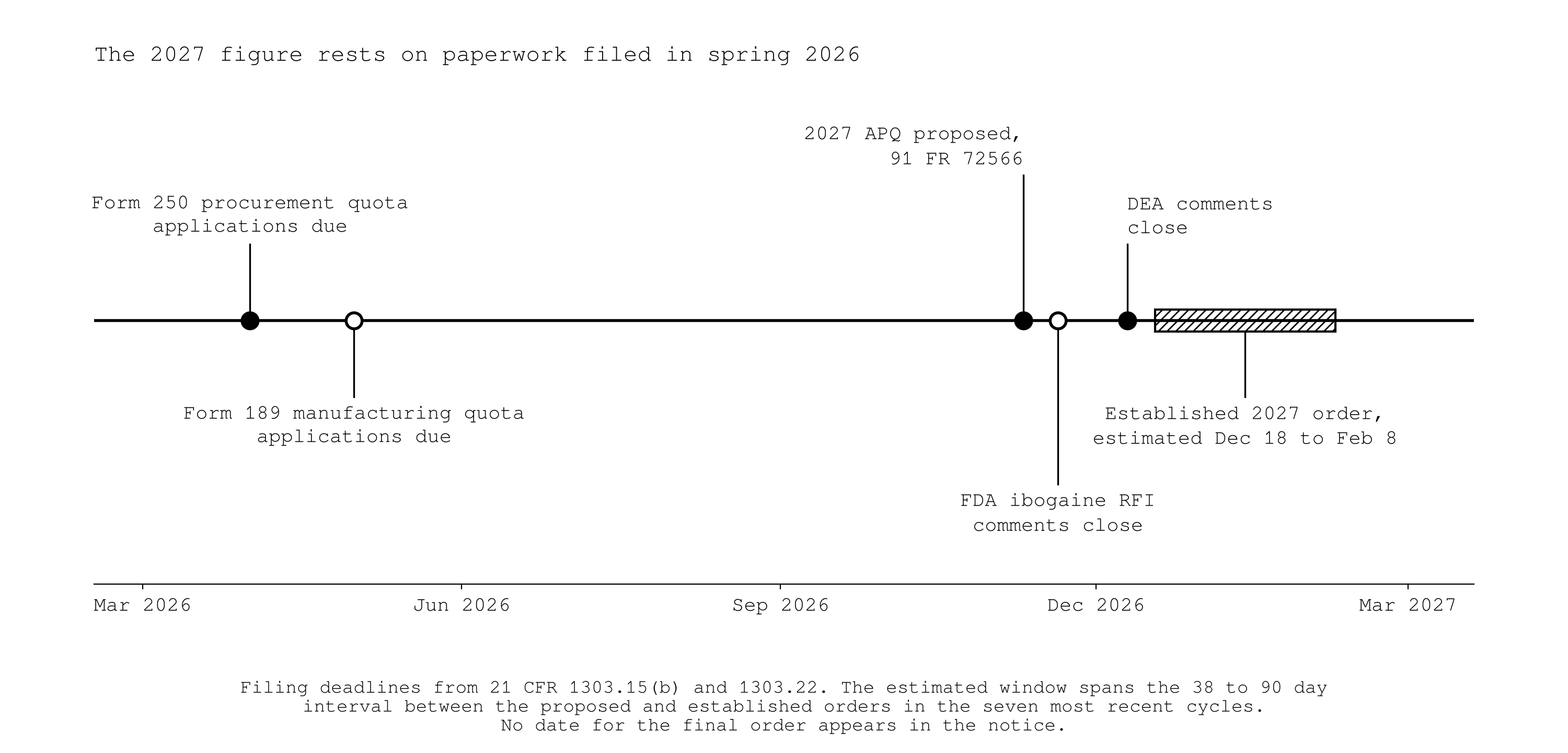
Basis for the estimate: the interval between the proposed and established orders in the seven most recent cycles was 38 to 90 days, median 62, which places the midpoint near January 11, 2027. DEA is required to fix individual manufacturing quotas on or before December 1 of each year (21 CFR 1303.21(a)), but the established quota order itself was published after December 1 in each of the last four cycles, so that date is not a reliable ceiling. No date for the final order appears in the notice.
Written by Odette Hauke. Claude Sonnet 5.5 assisted with citations and with assembling and organizing the content.
References
- Drug Enforcement Administration (DEA). (2017). Established aggregate production quotas for schedule I and II controlled substances for 2018. 82 FR 51873 (Nov. 8, 2017). Docket No. DEA-471F.
- Drug Enforcement Administration (DEA). (2018). Established aggregate production quotas for schedule I and II controlled substances for 2019. 83 FR 67348 (Dec. 28, 2018). Docket No. DEA-488E.
- Drug Enforcement Administration (DEA). (2019). Established aggregate production quotas for schedule I and II controlled substances for 2020. 84 FR 66014 (Dec. 2, 2019). Docket No. DEA-508E.
- Drug Enforcement Administration (DEA). (2020). Established aggregate production quotas for 2021. 85 FR 76604 (Nov. 30, 2020). Docket No. DEA-688E.
- Drug Enforcement Administration (DEA). (2021). Established aggregate production quotas for 2022. 86 FR 68513 (Dec. 2, 2021). Docket No. DEA-888.
- Drug Enforcement Administration (DEA). (2022). Established aggregate production quotas for 2023. 87 FR 74168 (Dec. 2, 2022). Docket No. DEA-1051E.
- Drug Enforcement Administration (DEA). (2023). Proposed adjustments to the aggregate production quotas for 2023. 88 FR 74512 (Oct. 31, 2023). Docket No. DEA-1051A.
- Drug Enforcement Administration (DEA). (2024a). Established aggregate production quotas for 2024. 89 FR 407 (Jan. 3, 2024). Docket No. DEA-1228E.'Drug Enforcement Administration (DEA). (2024b). Final adjusted aggregate production quotas for 2024. 89 FR 102638 (Dec. 17, 2024). Docket No. DEA-1228F.
- Drug Enforcement Administration (DEA). (2024b). Final adjusted aggregate production quotas for 2024. 89 FR 102638 (Dec. 17, 2024). Docket No. DEA-1228F.
- Drug Enforcement Administration (DEA). (2024c). Established aggregate production quotas for 2025. 89 FR 102649 (Dec. 17, 2024). Docket No. DEA-1413E.
- Drug Enforcement Administration (DEA). (2025a). Importer of controlled substances application: Catalent Pharma Solutions, LLC. 90 FR 10731 (Feb. 26, 2025). Docket No. DEA-1503.
- Drug Enforcement Administration (DEA). (2025b). Importer of controlled substances application: Catalent Pharma Solutions, LLC [ibogaine, LSD, 5-MeO-DMT, and psilocybin; filed June 11, 2025]. 90 FR 44240 (Sept. 12, 2025). Docket No. DEA-1592.
- Drug Enforcement Administration (DEA). (2025c). Bulk manufacturer of controlled substances application: Irvine Labs Inc. 90 FR 54385 (Nov. 26, 2025). Docket No. DEA-1627.
- Drug Enforcement Administration (DEA). (2026a). Established aggregate production quotas for 2026. 91 FR 287 (Jan. 5, 2026). Docket No. DEA-1568E.
- Drug Enforcement Administration (DEA). (2026b). Bulk manufacturer of controlled substances application: Benuvia Operations, LLC. 91 FR 28620 (May 18, 2026). Docket No. DEA-1714.
- Drug Enforcement Administration (DEA). (2026c). Importer of controlled substances application: Scottsdale Research Institute. 91 FR 36617 (June 17, 2026). Docket No. DEA-1724.
- Drug Enforcement Administration (DEA). (2026d). Importer of controlled substances application: Benuvia Operations, LLC. 91 FR 61251 (Sept. 28, 2026). Docket No. DEA-1767.
- Drug Enforcement Administration (DEA). (2026e). Importer of controlled substances application: Groff Health Inc. 91 FR 66152 (Oct. 19, 2026). Docket No. DEA-1781.
- Drug Enforcement Administration (DEA). (2026f). Bulk manufacturer of controlled substances application: Groff Health Inc. 91 FR 66154 (Oct. 19, 2026).
- Drug Enforcement Administration (DEA). (2026g). Bulk manufacturer of controlled substances application: Scottsdale Research Institute. 91 FR 66151 (Oct. 19, 2026). Docket No. DEA-1784.
- Drug Enforcement Administration (DEA). (2026h). Proposed aggregate production quotas for schedule I and II controlled substances and assessment of annual needs for the list I chemicals ephedrine, pseudoephedrine, and phenylpropanolamine for 2027. 91 FR 72566 (Nov. 10, 2026). Docket No. DEA-1730P.
- Exec. Order No. 14379. (2026). Addressing addiction through the Great American Recovery Initiative (Jan. 29, 2026). 91 FR 5081.
- Exec. Order No. 14401. (2026). Accelerating medical treatments for serious mental illness (Apr. 18, 2026). 91 FR 21709.
- Food and Drug Administration (FDA). (2026). Design and safety considerations for clinical trials involving ibogaine drug products; request for information. 91 FR 63563 (Oct. 6, 2026). Docket No. FDA-2026-N-10429.
- Psyence Biomedical Ltd. (2026, October 5). Psyence BioMed partners with DEA-registered Benuvia Operations to establish U.S. manufacture of pharmaceutical-grade ibogaine [News release].
Regulations cited
- 21 CFR 1303.03(a).
- 21 CFR 1303.11.
- 21 CFR 1303.13(b)(3).
- 21 CFR 1303.15(b).
- 21 CFR 1303.21(a).
- 21 CFR 1303.22.
- 21 CFR 1303.24(a).
- Molecular weights from PubChem CID 197060 (ibogaine, 310.4 g/mol) and CID 197059 (ibogaine hydrochloride, 346.9 g/mol).