
FDA’s ibogaine notice builds its cardiac reasoning on a guidance that was reissued twenty-four days later. The revision matters, because it contains the only regulatory route an ibogaine program can actually take.
On October 6, 2026, FDA opened Docket No. FDA-2026-N-10429, a Request for Information (RFI) on early-phase ibogaine trial design, for comment through November 20, 2026 (FDA, 2026a). It follows Executive Order 14401 of April 18, 2026, on accelerating psychedelic treatments (Executive Order 14401, 2026), and the psychedelic drugs guidance finalized that July (FDA, 2026c). Its cardiac reasoning rests on one instrument, cited as the August 2022 E14 and S7B questions and answers (FDA, 2026a).
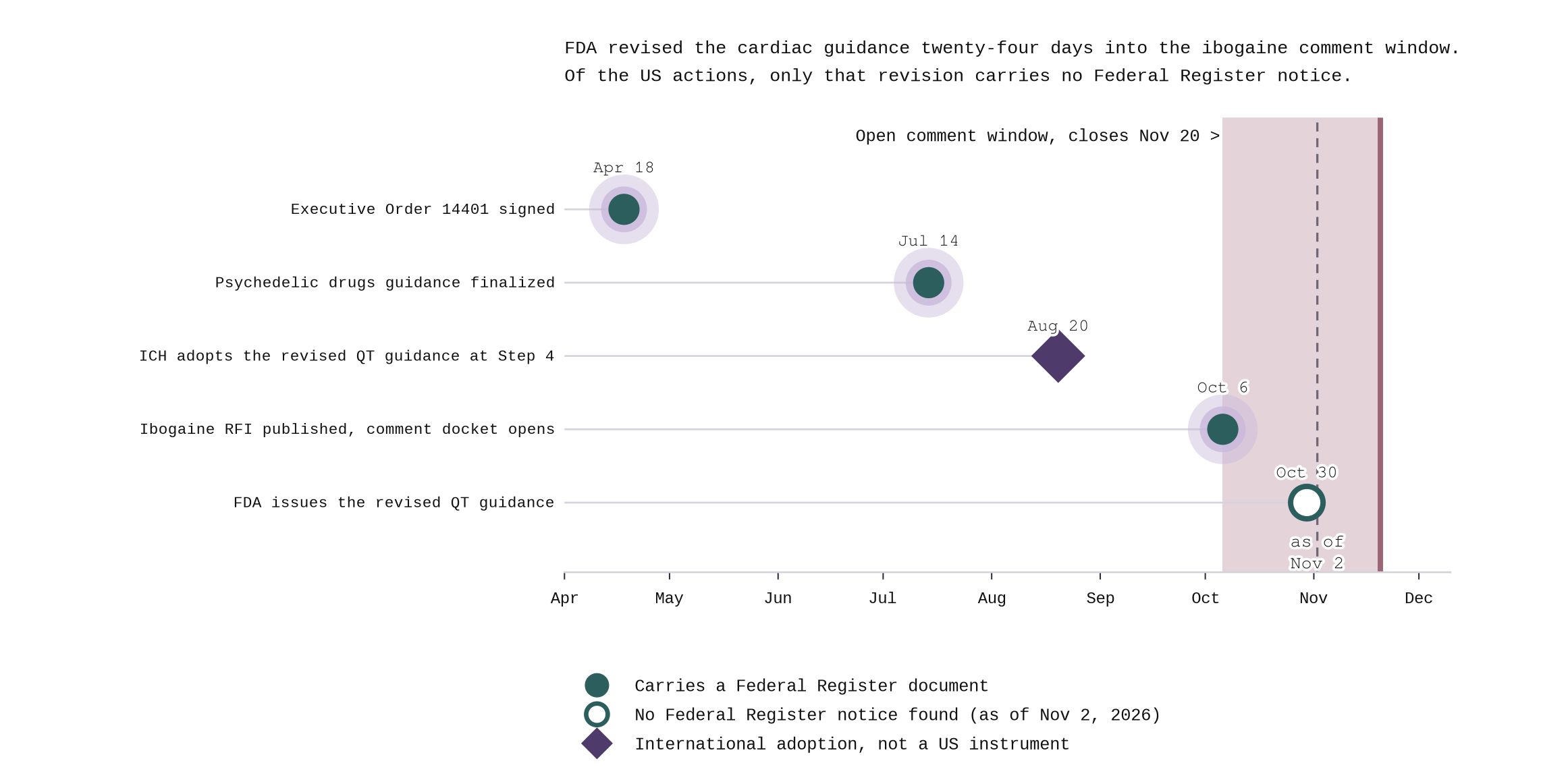
Twenty-four days later that document was replaced. The file at the URL the notice cites now reads October 2026, Revision 1, and the server reports it last modified on October 30, 2026 (FDA, 2026b). The text was adopted by the ICH Assembly under Step 4 on August 20, 2026, and it revises exactly the questions that decide how ibogaine can be evaluated at all (FDA, 2026b).
ICH E14 itself dates from October 2005 and has never been revised (FDA, 2026a; ICH, 2005), but the Q&A that operationalizes it is a separate document, with Step 4 approvals in 2008, 2012, 2014, 2015, 2022, and now 2026 (FDA, 2026b).
1. Ibogaine Misses E14’s Decision Threshold by More than Two Orders of Magnitude
E14’s central decision rule is a number. Where concentration-response analysis is the primary basis for classification, the upper bound of the two-sided 90 percent confidence interval for the QTc effect must be below 10 ms at the highest clinically relevant exposure to avoid expanded ECG evaluation later in development (FDA, 2026b).
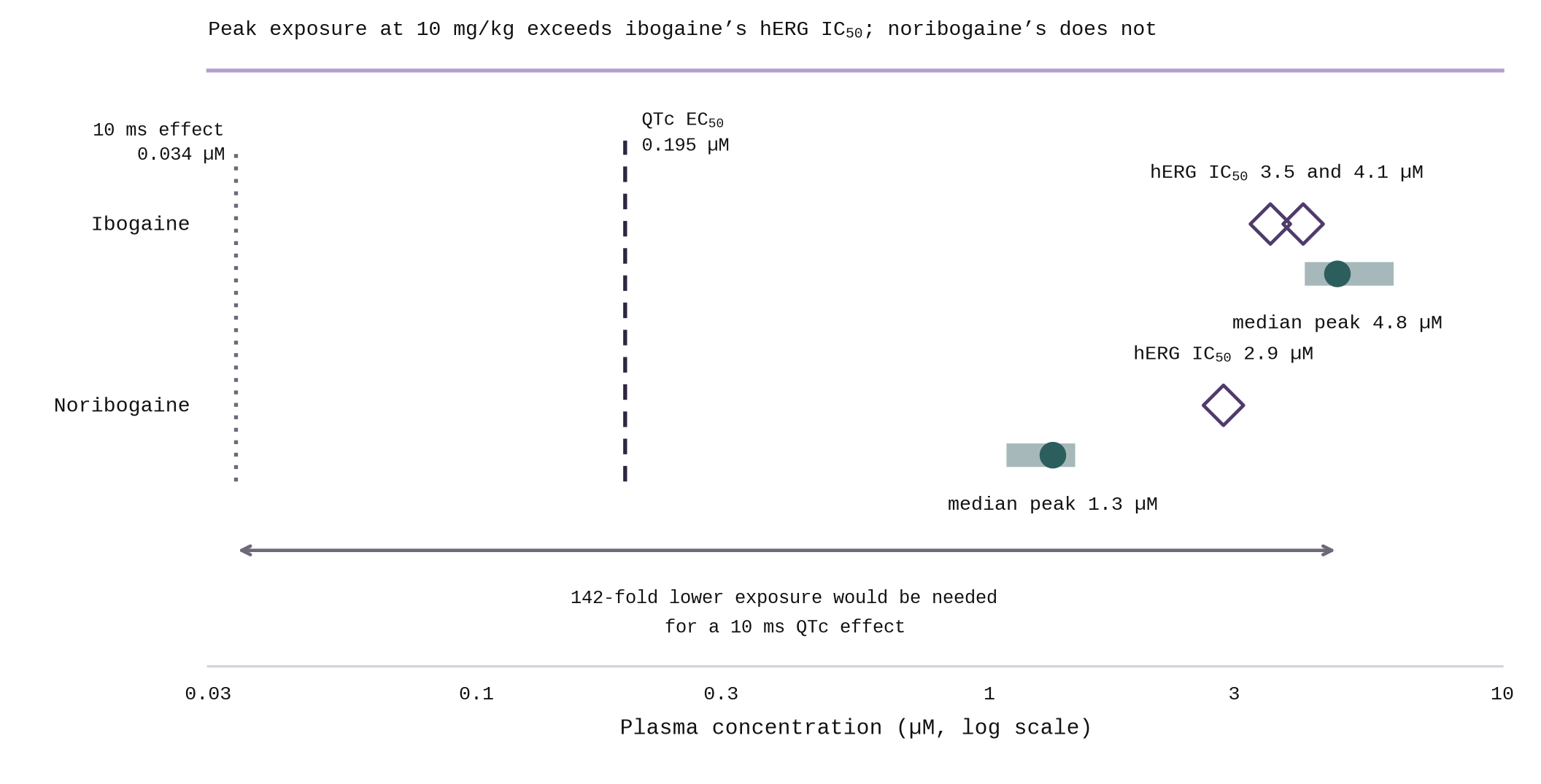
Ibogaine is not close. The only published concentration-QTc model, built on 386 ECG measurements in 14 patients with opioid use disorder given a single 10 mg/kg dose, fits a sigmoid Emax relationship: maximum QTc prolongation 67.9 ms (relative standard error 10.9 percent), EC50 0.195 µM (RSE 64.1 percent). Median peak concentration was 4.77 µM, interquartile range 4.12 to 6.14 µM (Knuijver et al., 2024).
Median peak exposure therefore sits about 24-fold above the EC50, putting the response at roughly 96 percent of its modeled maximum before escalation begins. The curve is saturated: escalating to 10 mg/kg characterizes exposure, not dose-response (FDA, 2026a). Assuming a Hill coefficient of 1, which the model does not report, peak concentration would have to fall about 142-fold, to roughly 0.034 µM, for a 10 ms effect. The authors put it conservatively: more than a ten-fold reduction would be needed (Knuijver et al., 2024).
2. The In Vitro Margin Is Below One, and the Revision Specifies How to Compute It
Revised S7B Q&A 1.3 sets out the method: normalize the half-inhibitory concentration to clinically relevant exposure, use free drug where protein binding is reliably measured, and anchor the denominator to high clinical exposure rather than the ordinary therapeutic one (FDA, 2026b).
On total plasma concentration the arithmetic is uncomfortable. Measured hERG IC50 values are 4.09 µM for ibogaine made by semisynthesis from voacangine and 3.53 µM for the extract from Tabernanthe iboga, with noribogaine at 2.86 µM (Alper et al., 2016). Against a median peak of 4.77 µM, ibogaine’s margin is 0.86 and 0.74, staying below 1 across the interquartile range. Noribogaine’s is 2.15. Peak exposure to the parent drug exceeds the concentration that half-blocks the channel it acts on.
The free-drug calculation the guidance prefers cannot be done: ibogaine’s plasma protein binding is not reported in the pharmacokinetic study and not located in the sources retrieved here. Q&A 1.3 anticipates this, instructing sponsors to present both free and total margins and to benchmark against reference drugs of known torsades risk on the same protocol (FDA, 2026b). No such series exists for ibogaine.
One finding in the same dataset cuts the other way. Across the iboga alkaloids hERG binding affinities span a narrow 0.71 to 3.89 µM, yet 18-methoxycoronaridine blocks the channel with an IC50 above 50 µM (Alper et al., 2016). The liability is separable from the scaffold: a compound can occupy the channel without blocking it. That is the basis for the analog programs, and FDA has separately allowed an early-phase noribogaine hydrochloride study to proceed under an IND in alcohol use disorder (FDA, 2026a). A 2026 Addiction review urges the same (Brunt, 2026).
3. Revised Q&A 6.1 Describes Ibogaine’s Constraints Almost Exactly
The revision rewrote Q&A 6.1, on what to do when a thorough QT study is not feasible. It names three triggering circumstances: placebo-controlled comparison is impossible, safety precludes supratherapeutic doses, and safety or tolerability prohibit use in healthy participants (FDA, 2026b). An ibogaine program satisfies all three, and the answer adds a line that reads as though written for it: the absence of placebo and healthy-participant dosing does not preclude interpretation (FDA, 2026b).
In its place it substitutes an integrated nonclinical and clinical assessment, allowing a totality-of-evidence argument for low proarrhythmic likelihood even where the upper bound around maximal change in QTc exceeds 10 ms, turning on the hERG margin and clinical data quality (FDA, 2026b). That is the only door an ibogaine program can walk through, and it opened after the notice was drafted.
4. The Contemplated Design Excludes the Exposure the Margin Is Anchored To
Q&A 1.3’s denominator is high clinical exposure: peak concentration when the maximum therapeutic dose meets whichever factor raises it most (FDA, 2026b). Both of ibogaine’s candidate factors are known, and the design removes both.
The intrinsic factor is CYP2D6, which the Addiction review flags as a cardiovascular risk amplifier (Brunt, 2026). In the population model, ibogaine clearance is 0.82 L/h at activity score 0 and rises 30.7 L/h per point, implying a roughly 113-fold spread across scores 0 to 3; the paper calls this more than ten-fold (Knuijver et al., 2024). The notice proposes enrolling only fast and intermediate metabolizers (FDA, 2026a). The extrinsic factor is CYP2D6 inhibition, characterized in one study: six days of paroxetine before a 20 mg ibogaine dose in 21 healthy volunteers, phenotype correlated to exposure (r = 0.82 for AUC, 0.77 for Cmax), active moiety roughly doubled, and poor metabolizers advised at least half the intended dose (Glue et al., 2015b). The notice directs that paroxetine and sertraline be stopped before dosing (FDA, 2026a).
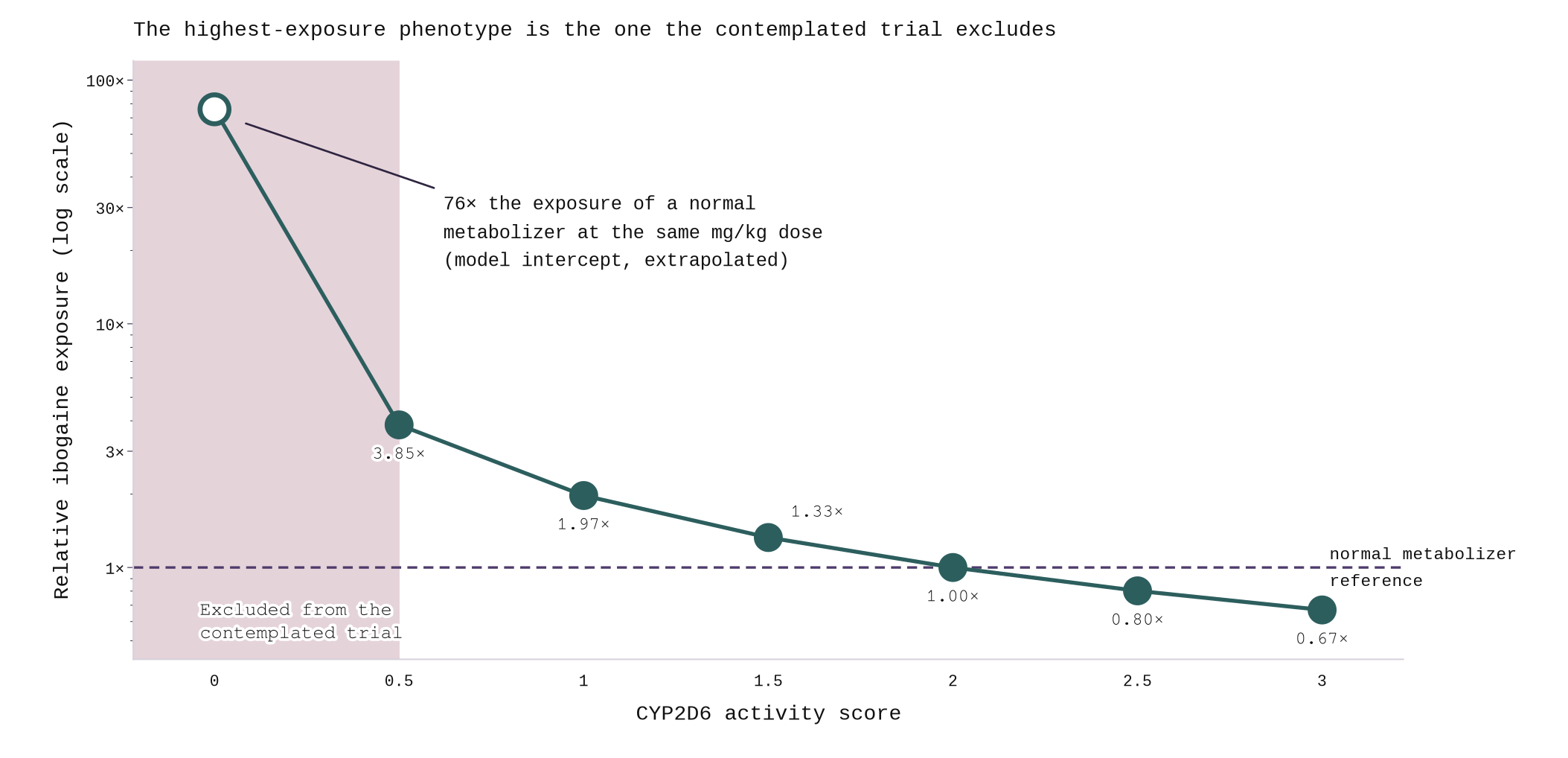
Both exclusions are defensible as patient protection. Together they mean the trial will not observe the exposure the revision says should anchor the margin, and the only reduced-CYP2D6 data come from a dose one thirty-fifth of therapeutic (FDA, 2026b; Glue et al., 2015b).
5. The Paired PK and ECG Data Exist, and They Are Thinner than the Citation Suggests
FDA asks what would make data from settings outside the United States useful, including the individual-level pharmacokinetic and electrocardiographic information needed to interpret it (FDA, 2026a). That dataset exists, in one place. The companion safety report on the same 14 patients found mean maximum QTcF prolongation of 95 ms (range 29 to 146), half of participants above 500 ms, and 6 of 14 still above 450 ms beyond 24 hours; no torsades de pointes occurred (Knuijver et al., 2022). ECGs ran every half hour for the first 12 hours, not continuously, so brief episodes could have been missed (Knuijver et al., 2022). The modeled maximum of 67.9 ms is well below the 95 ms observed mean maximum in the same cohort, a gap the published work does not reconcile (Knuijver et al., 2022, 2024). The rank correlation between ibogaine concentration and QTc is 0.109, called modest in the paper’s text, while the abstract presents 0.109 as the p-value for noribogaine; both cannot be right (Knuijver et al., 2024).
The directional conclusion, that QTc tracks parent rather than metabolite, is still the most useful finding available, and the metabolite’s own data partly contradict it. Noribogaine alone, in 27 methadone-maintained patients at 60, 120, and 180 mg, produced a concentration-dependent QTcI increase of 0.17 ms per ng/mL, largest mean effects near 16, 28, and 42 ms (Glue et al., 2016), and it clears slowly, mean half-life 28 to 49 hours (Glue et al., 2015a). The metabolite prolongs QTc by itself, and it lingers. Any model omitting either moiety is misspecified, and revised Q&A 5.1 flags this case directly (FDA, 2026b).
A specification gap sits in the notice itself. The enrollment criterion names Fridericia, but the 500 ms stopping trigger names no formula (FDA, 2026a). Ibogaine causes bradycardia, where the formulas diverge in the direction that matters: a beat reading 500 ms by Fridericia reads 485.0 ms by Bazett at 50 bpm and 476.6 ms at 45 bpm. That is roughly 15 ms of unstated tolerance in ibogaine’s own heart-rate range.
6. No Published Design Can Tell You What the Magnesium Did
FDA asks what design would best distinguish the QTc effects of ibogaine alone from ibogaine with magnesium pretreatment (FDA, 2026a). It is the sharpest question in the notice, and nothing in the literature answers it.
The two published protocols use magnesium in opposite roles and neither isolates it. The Stanford MISTIC protocol gave it as pretreatment to 30 male Special Operations Forces veterans and reported no unexpected or serious adverse events, but it was open-label and observational with no magnesium-free comparator, and its authors called for controlled trials (Cherian et al., 2024). Its methodology and registration adherence have since been challenged in the International Journal on Drug Policy (Gorman, 2026). The Dutch protocol used magnesium as rescue: 10 mmol when QTc exceeded 500 ms within 24 hours, then 10 mmol over 10 hours (Knuijver et al., 2022). Rescue is conditioned on the outcome, so treated participants are by construction those with the largest prolongation.
A design that can answer it follows from what Q&A 6.1 permits. Magnesium has to be a randomized, concurrent assignment rather than a background co-intervention, both arms at the same ibogaine dose, compared on concentration-corrected change in QTc rather than raw maxima, so the effect is not confounded by CYP2D6 exposure. The primary analysis should be a prespecified concentration-QTc model carrying ibogaine and noribogaine as separate exposure terms with magnesium status as a covariate, structural model and hysteresis testing fixed before unblinding, as Q&A 5.1 requires (FDA, 2026b). Serum and ionized magnesium belong alongside each ECG: the achieved concentration, not the bolus, is what matters. And because rescue will be ethically mandatory, the protocol needs a prespecified rule for rescued participants, or the rescue becomes the exposure under study.
7. What a Program Can Price, and What It Cannot
For anyone allocating capital here, the question is not whether ibogaine prolongs QTc. That is settled and bounded: a saturating effect with a modeled maximum near 68 ms, a known metabolite contribution, and a genotype explaining most of the exposure variance (Glue et al., 2016; Knuijver et al., 2024). Risk of that shape can be priced. The standard cannot. The notice establishes no requirements and is not the Agency’s final view (FDA, 2026a); the guidance that will govern the assessment was reissued inside the comment window, with no Federal Register notice of availability as of November 2, 2026 (Federal Register, 2026); and the Agency has not said whether it will assess ibogaine under Q&A 6.1, the only provision whose triggering conditions the drug meets.
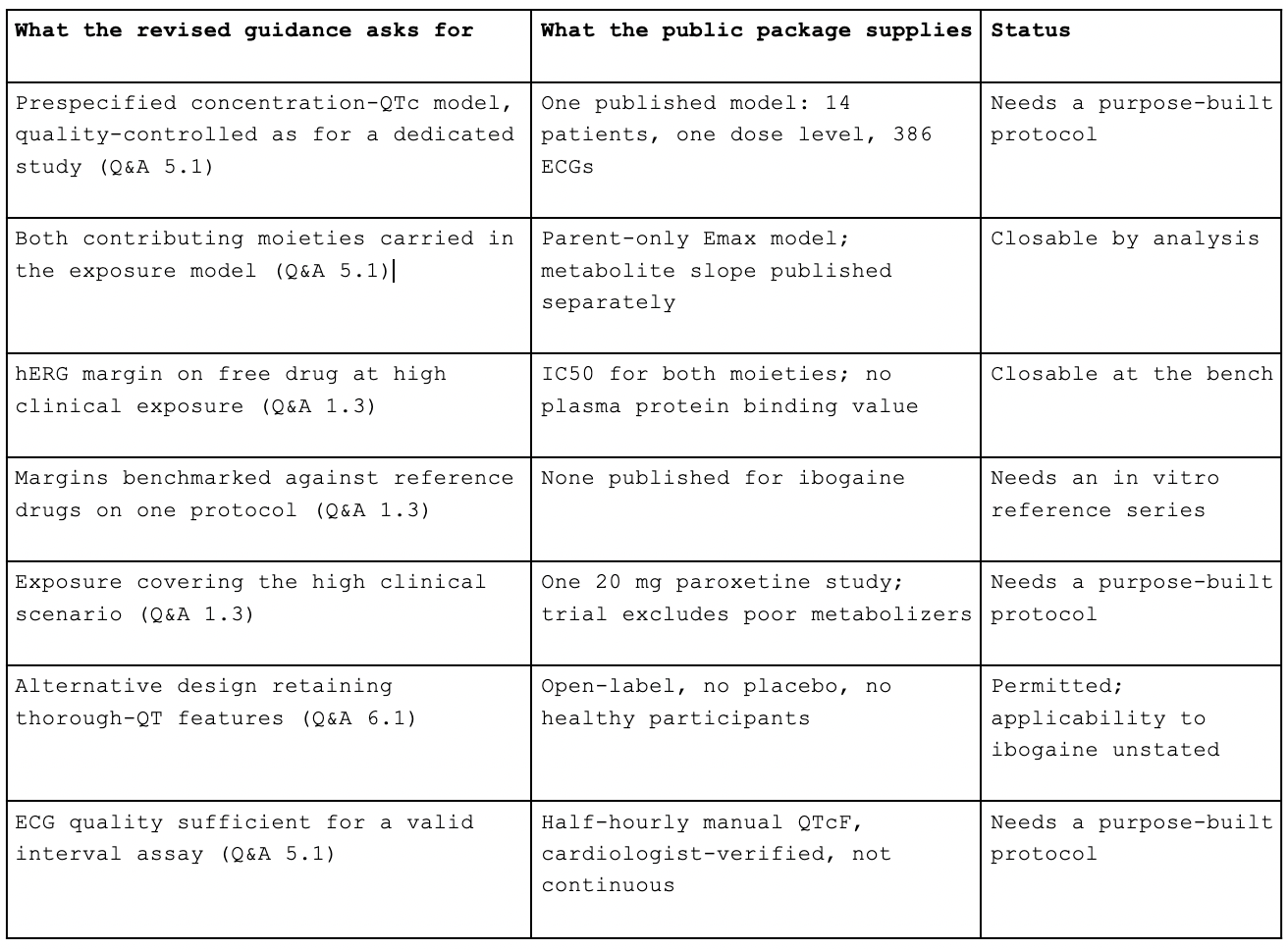
The gap is not uniform. Two rows close with analysis rather than new clinical work: a joint parent-and-metabolite exposure model fits data that already exist, and protein binding is a bench measurement. Three close only with a protocol written for the purpose, which is what the comment window is for. Whether ibogaine is assessed under Q&A 6.1 at all is the question no sponsor can answer alone, and the window closes on November 20, 2026, exactly three weeks after the guidance that will govern the answer replaced itself (FDA, 2026a, 2026b).
Method, and What Is Not Established Here
Verified against primary records: the RFI text, docket number, dates, eligibility and stopping criteria, magnesium question, and reference list from the Federal Register notice of October 6, 2026; the guidance’s revision history, Step 4 date, Q&A 5.1, 6.1, and 1.3 text, and the 10 ms decision rule from the guidance PDF; the October 30, 2026, posting from that file’s HTTP last-modified header; the absence of a notice of availability from the Federal Register API. Verified against peer-reviewed literature: all pharmacokinetic, ECG, hERG, and magnesium figures, retrieved via PubMed.
Author’s derivations, inputs named: the ratio of median peak concentration to EC50 (24-fold) and the fraction of maximum effect (96 percent) follow from the published Emax and EC50 estimates. The 142-fold figure additionally assumes a Hill coefficient of 1, which the model does not report; a steeper coefficient would reduce it. The hERG margins divide published IC50 values by published median and quartile peak concentrations on a total-drug basis, across two studies in different populations. The 113-fold clearance spread and the relative exposures in Figure 3 are computed from the paper’s own activity-score coefficients; no participant is confirmed at a score of 0, since the per-individual genotype table sits in supplementary material not retrieved here, so that point is a model intercept rather than an observation. The Bazett and Fridericia divergence is computed from the standard formulas at 45 and 50 bpm.
Not established: ibogaine’s plasma protein binding, and therefore the free-drug hERG margin the revision prefers; any reference-drug margin series on a common protocol; whether FDA intends to treat ibogaine under Q&A 6.1; and the contents of the International Journal on Drug Policy commentary, cited by title and venue only because no abstract was available. The discrepancy between the 67.9 ms modeled maximum and the 95 ms observed mean maximum is reported, not resolved. The capital-allocation framing in section 7 is interpretation, not a finding.
Disclosure
Odette Hauke is an independent regulatory affairs consultant advising sponsors developing oncology, rare disease, and psychedelic drugs including LSD, MDMA, DMT, and ibogaine; previously Associate Director of Regulatory Affairs at AtaiBeckley, which Eli Lilly acquired in September 2026, and consultant to its ibogaine, R-MDMA, and DMT programs. She has no financial interest in or advisory relationship with Stanford, Ambio Life Sciences, Radboud University Medical Center, or DemeRx.
Written by Odette Hauke. Claude Sonnet 5.5 assisted with citations and with assembling and organizing the content.
References
- Alper K, Bai R, Liu N, Fowler SJ, Huang X-P, et al. (2016). “hERG Blockade by Iboga Alkaloids.” Cardiovascular Toxicology, January 2016. https://doi.org/10.1007/s12012-015-9311-5
- Brunt TM. (2026). “Rare but relevant: Ibogaine and cardiovascular complications: prolonged QT interval and ventricular arrhythmias.” Addiction 121(6):1616-1621. https://doi.org/10.1111/add.70319
- Cherian KN, Keynan JN, Anker L, Faerman A, Brown RE, et al. (2024). “Magnesium-ibogaine therapy in veterans with traumatic brain injuries.” Nature Medicine, January 2024. ClinicalTrials.gov NCT04313712. https://doi.org/10.1038/s41591-023-02705-w
- Executive Order 14401. (2026). Executive Order 14401 of April 18, 2026, “Accelerating Medical Treatments for Serious Mental Illness.” 91 FR 21709, April 22, 2026. https://www.federalregister.gov/d/2026-07455
- FDA (Food and Drug Administration). (2026a). “Design and Safety Considerations for Clinical Trials Involving Ibogaine Drug Products; Request for Information.” Docket No. FDA-2026-N-10429. 91 FR 63563, October 6, 2026. FR Doc. 2026-20427. https://www.govinfo.gov/content/pkg/FR-2026-10-06/html/2026-20427.htm
- FDA (Food and Drug Administration). (2026b). “E14 and S7B Clinical and Nonclinical Evaluation of QT/QTc Interval Prolongation and Proarrhythmic Potential: Questions and Answers (R1).” Guidance for Industry, October 2026, Revision 1. ICH Assembly Step 4, August 20, 2026. File retrieved November 2, 2026; server last-modified October 30, 2026. https://www.fda.gov/media/161198/download
- FDA (Food and Drug Administration). (2026c). “Psychedelic Drugs: Considerations for Clinical Investigations.” Final guidance for industry, July 14, 2026. 91 FR 43101. https://www.fda.gov/media/169922/download
- Federal Register. (2026). Federal Register API, searched November 2, 2026 for “E14 and S7B,” “QT/QTc Interval Prolongation,” and “Proarrhythmic Potential” from October 1, 2026. The ibogaine RFI is the only matching document; no notice of availability for the revised guidance had published. https://www.federalregister.gov/api/v1/documents.json
- Glue P, Lockhart M, Lam F, Hung N, Hung CT, Friedhoff L. (2015a). “Ascending-dose study of noribogaine in healthy volunteers: pharmacokinetics, pharmacodynamics, safety, and tolerability.” Journal of Clinical Pharmacology. https://doi.org/10.1002/jcph.404
- Glue P, Winter H, Garbe K, Jakobi H, Lyudin A, et al. (2015b). “Influence of CYP2D6 activity on the pharmacokinetics and pharmacodynamics of a single 20 mg dose of ibogaine in healthy volunteers.” Journal of Clinical Pharmacology. https://doi.org/10.1002/jcph.471
- Glue P, Cape G, Tunnicliff D, Lockhart M, Lam F, et al. (2016). “Ascending Single-Dose, Double-Blind, Placebo-Controlled Safety Study of Noribogaine in Opioid-Dependent Patients.” Clinical Pharmacology in Drug Development. https://doi.org/10.1002/cpdd.254
- Gorman I. (2026). “Non-adherence to registration further undermines the methodologically weak Stanford University Magnesium-Ibogaine Study.” International Journal on Drug Policy. Cited by title and venue; no abstract available and full text not retrieved. https://doi.org/10.1016/j.drugpo.2026.105408
- ICH (International Council for Harmonisation). (2005). “E14 Clinical Evaluation of QT/QTc Interval Prolongation and Proarrhythmic Potential for Non-Antiarrhythmic Drugs.” FDA guidance for industry, October 2005. Cited in the ibogaine RFI as the parent guideline. https://www.fda.gov/media/71372/download
- Knuijver T, Schellekens A, Belgers M, Donders R, van Oosteren T, et al. (2022). “Safety of ibogaine administration in detoxification of opioid-dependent individuals: a descriptive open-label observational study.” Addiction 117(1):118-128. https://doi.org/10.1111/add.15448
- Knuijver T, ter Heine R, Schellekens AFA, Heydari P, Lucas L, et al. (2024). “The pharmacokinetics and pharmacodynamics of ibogaine in opioid use disorder patients.” Journal of Psychopharmacology 38(5):481-488. https://doi.org/10.1177/02698811241237873