
The "one dose, lasting benefit" narrative for psilocybin does not survive contact with the Phase 3 data.
In treatment-resistant depression, psilocybin will most often be used as a chronic-intermittent therapy, and payers will price, authorize and contract for it on that basis whether or not the label says so.
- Durability of effect. Only 25% of the COMP005 25 mg arm held even a 25% MADRS reduction from week 6 to week 26 after a single dose; COMP006 needed two doses to reach 39% at the same bar. The mean drug effect decays by week 6;
- Retreatment. Roughly 80% of 25 mg participants still in COMP005 at week 52 received open-label treatment, and second doses converted 30% to 40% of partial responders to remission;
- Three readministration models: episodic (one course per episode, perhaps a quarter to a third of patients), chronic-intermittent (2 to 4 doses a year, the modal pattern), and chronic (scheduled maintenance, not supported or feasible for psilocybin);
- For payers, frequency drives cost. Each dose carries 6 to 8 hours of monitored labor billed under unpriced Category III codes on the medical benefit, alongside a drug claim on the pharmacy benefit. Retreatment criteria, frequency caps and the response definition will be where coverage is won or lost;
- The sponsor's job before launch is to turn retreatment from an observed behavior into a defined regimen, with claims-ready triggers, Kaplan-Meier durability data and per-course pricing.
1. The Evidence Base: Fast Onset, a Decaying Mean Effect, a Durable Response in a Subpopulation
Onset is fast in nearly everyone who responds, but single-exposure durability is confined to a minority: the mean drug effect decays within weeks, and most benefit seen beyond week 6 in the Phase 3 program coincides with retreatment.
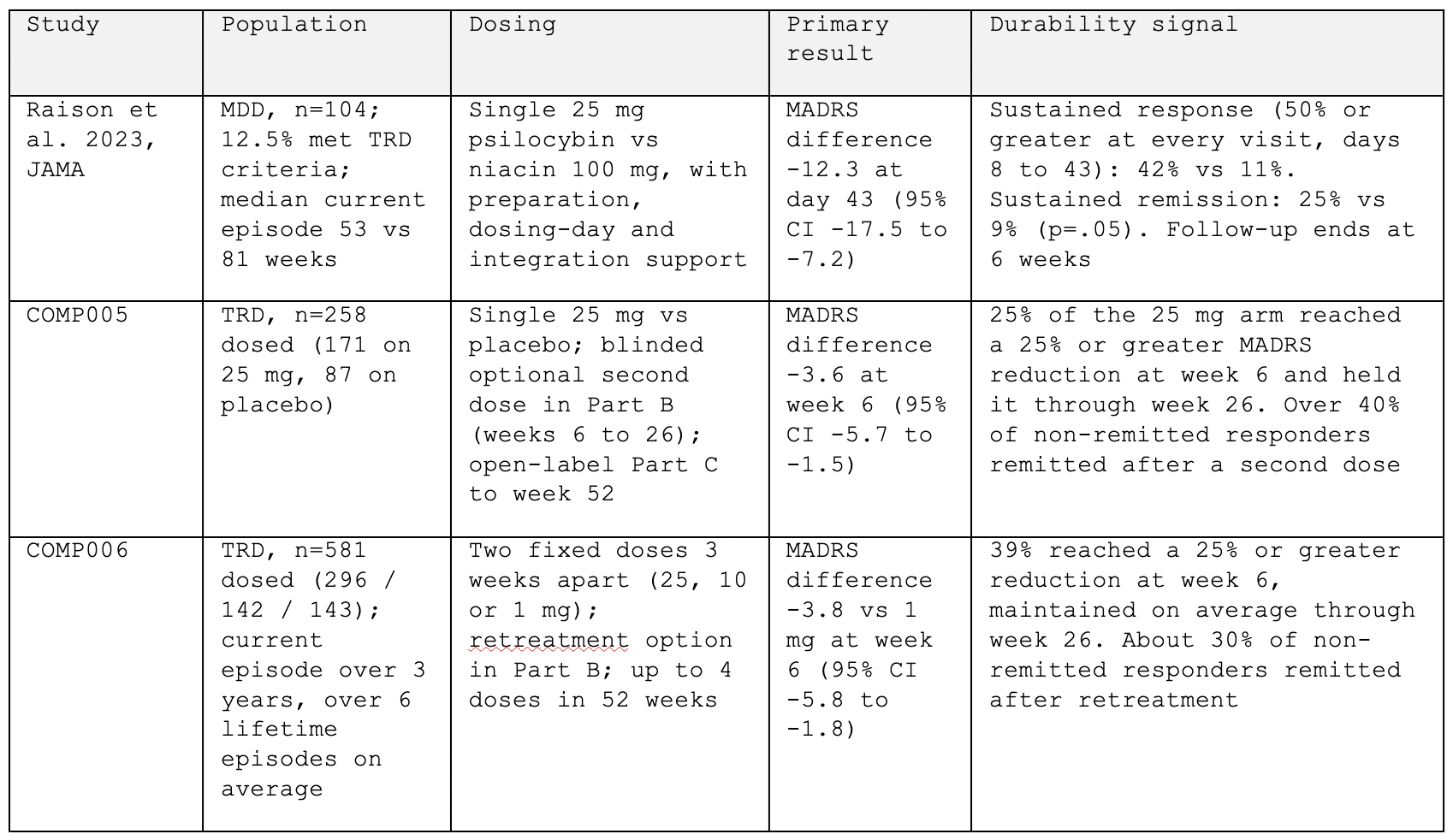
Five findings matter for retreatment in the TRD population.
- The mean effect decays. In COMP005 the 25 mg arm reaches roughly -10 MADRS points at day 2 and week 1, then drifts to roughly -5 by week 6 while placebo sits near -2 (values read from the presented slides). COMP006 concedes the point by design: the second dose at week 3 is built in, and the 25 mg efficacy curve deepens again after it;
- The response bar is set differently in Compass Pathways studies. Compass defines "a clinically meaningful response" as a 25% or greater MADRS reduction, half the conventional 50% response threshold. By that standard, about three in four COMP005 patients still did not hold a single-dose response to week 26. Payers and health technology assessors will likely recompute these data based on 50% response and MADRS 10 or below remission;
- Retreatment by week 52. Roughly 80% of 25 mg subjects remaining in COMP005 Part C received open-label treatment (about 90 of 113 per the slide), and the further improvement to roughly -13 points at week 52 coincides with that retreatment;
- A second dose converts partial responders into remitters. The over-40% (COMP005) and about-30% (COMP006) remission rates after a second dose suggest the first dose often initiates rather than completes the response;
- Raison et al. 2023 is the most favorable single-dose signal, from the least refractory MDD population. Mostly non-TRD patients with a median episode of about one year achieved 25% sustained remission over 6 weeks. That points to durability being a property of the patient population as much as the molecule, but the trial cannot speak to months 2 to 12.
2. Three Readministration Models
The three models differ in what triggers the next dose: a new episode, a relapse, or a calendar.
- Episodic. A course induces remission that outlasts the episode; the next course is given only for a new episode. Precedents: an acute ECT course, a course of antibiotics. Fits durable remitters;
- Chronic-intermittent. An induction course, then retreatment when symptoms return (symptom-triggered) or at fixed intervals (scheduled). Precedents: TMS retreatment courses, rituximab re-dosing on flare in rheumatoid arthritis, Botox every 12 weeks in chronic migraine (the scheduled variant). Fits partial responders and responders who relapse within months;
- Chronic. Continuous scheduled dosing, regardless of symptom state, to prevent relapse. Precedents: esketamine maintenance weekly or every 2 weeks, daily oral antidepressants. Requires relapse-prevention evidence, which does not exist for psilocybin.
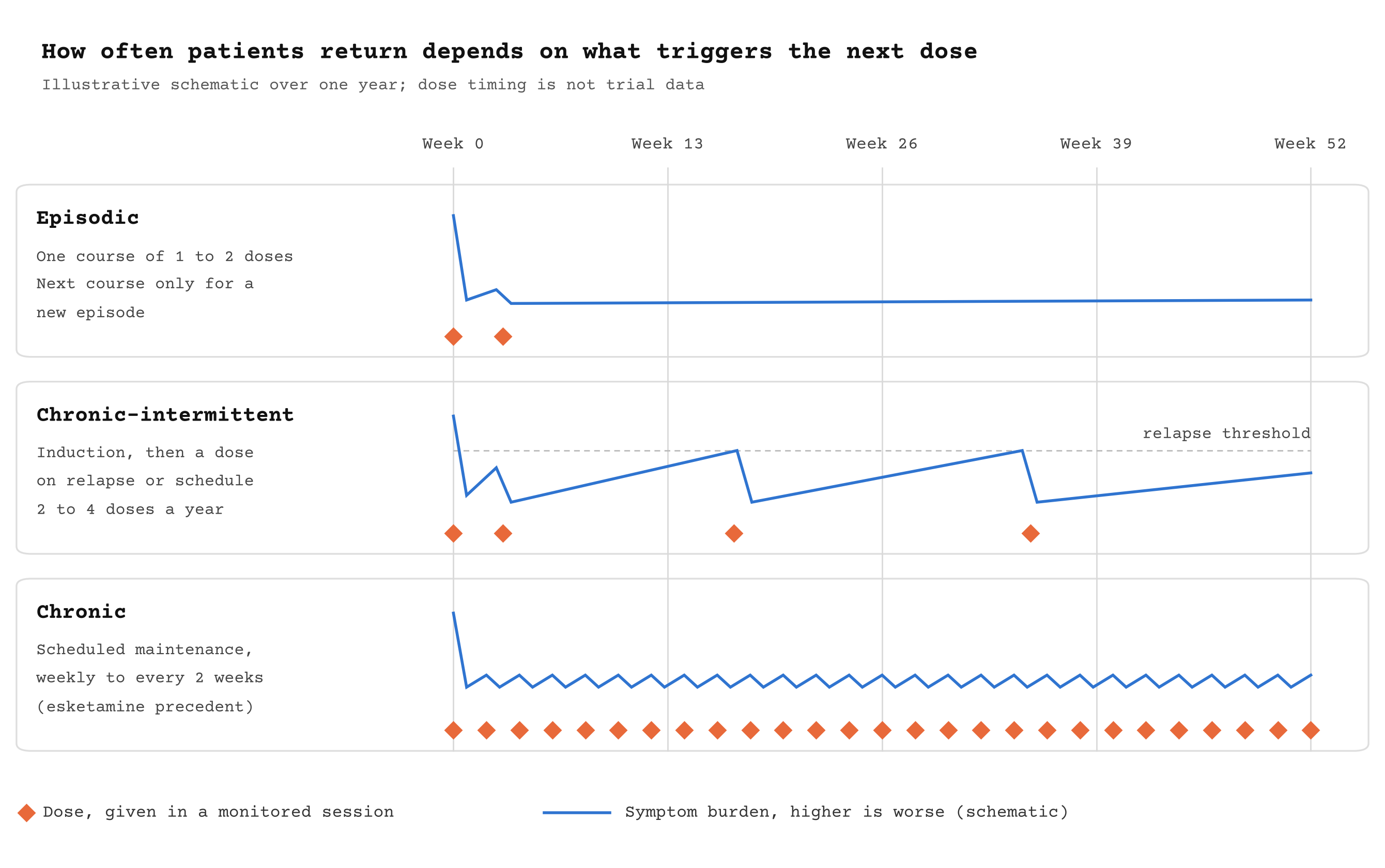
Two chronic-intermittent variants matter to payers. Symptom-triggered dosing means fewer doses but requires documented relapse. Scheduled dosing is predictable but invites retreatment of patients who are still well.
3. What the Data Support, by Patient Subgroup
The data point mostly to chronic-intermittent dosing in TRD and, for a subgroup, episodic dosing. There is no evident case for scheduled chronic dosing of psilocybin.
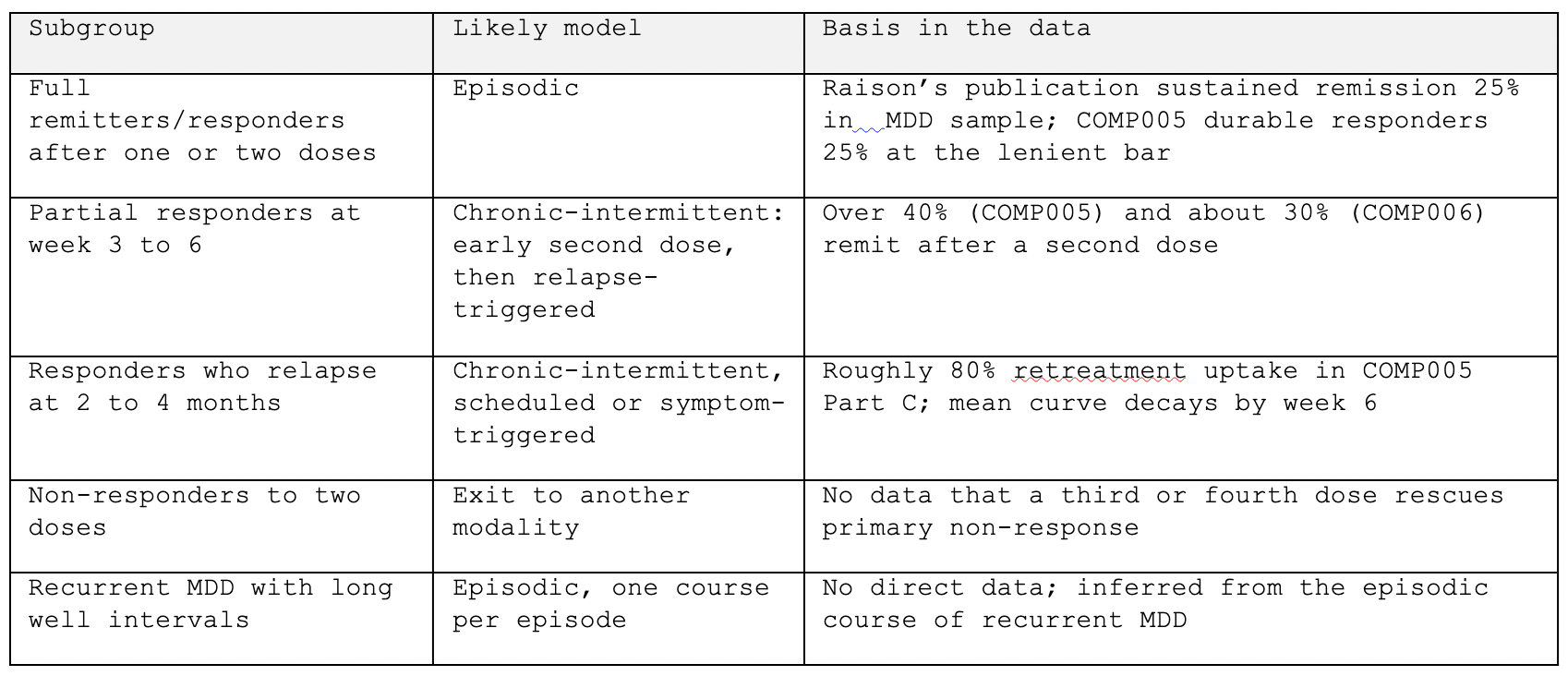
The evidence questions that decide which model a payer will accept:
- Time to relapse after response, as Kaplan-Meier curves;
- Response to the third and fourth dose. Tachyphylaxis, stable response and sensitization each imply a different long-run cost curve;
- Predictors of durability: episode length, number of failed treatments, baseline severity, acute subjective experience. Without them, the episodic subgroup cannot be identified up front;
- Fixed-interval versus symptom-triggered retreatment, randomized. This is the trial that defines chronic-intermittent as a regimen rather than a pattern of use;
- Randomized withdrawal or relapse prevention, the design that established esketamine maintenance (SUSTAIN-1) and the only rigorous route to a chronic indication;
- Cumulative safety over years of repeated exposure, including serotonergic 5-HT2B agonism,which matters less at two doses a year and a great deal more;
- Whether the intensity of psychological support changes durability. If it does, the support model is part of the product, and part of the retreatment cost.
4. Third-Party Payer Implications
Readministration frequency, more than drug price, will set payer economics: every dose carries 6 to 8 hours of monitored clinical labor on the medical benefit, billed under codes most payers do not yet price.
What Each Readministration Means for Reimbursement
Compass expects the drug to move through specialty pharmacy and buy-and-bill, reimbursed on the pharmacy benefit, with session monitoring billed hourly on the medical benefit under the psychedelic Category III CPT codes (0820T, 0821T, 0822T, effective January 1, 2024). Each readministration therefore triggers:
- a drug claim, on the pharmacy or medical side depending on channel;
- 6 to 8 hours of 0820T, plus 0821T or 0822T where a second monitor is present;
- preparation and integration visits billed as E/M or psychotherapy;
- a REMS-certified site and a room held for most of a working day.
Three consequences follow. First, two authorizations per dose (drug and session) can diverge, with the drug approved and the session denied. Second, Category III codes carry no national RVUs, are carrier-priced, and are routinely classed as investigational in commercial policies, so the monitoring line is the weakest link in coverage. Third, Medicare has a precedent for a product-specific fix: CMS created HCPCS G2082 and G2083 for supervised esketamine self-administration, and an analogous code for a 6 to 8 hour session is the cleanest path.
The Three Models Side by Side
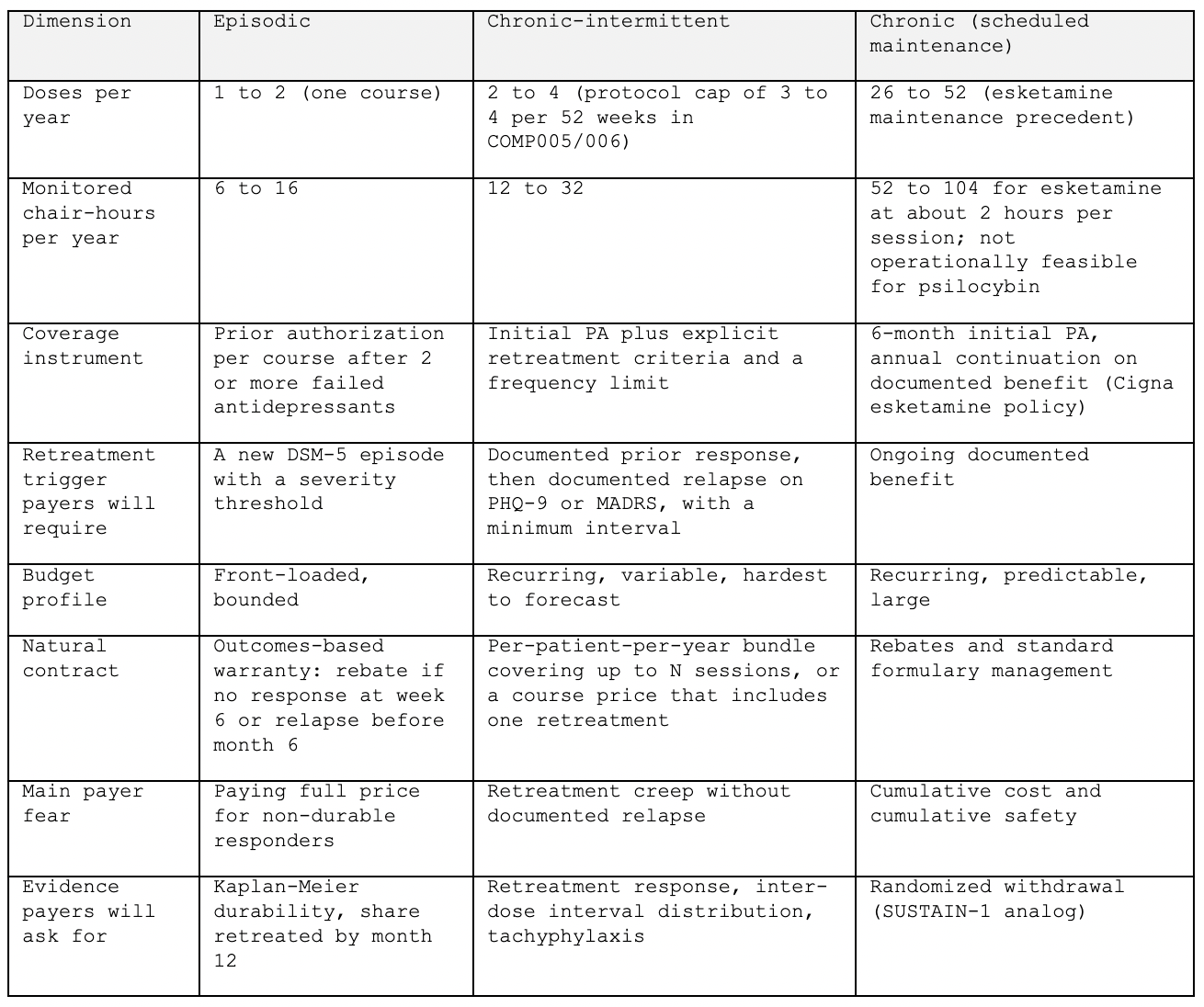
Chair-hours assume 6 to 8 monitored hours per psilocybin session and about 2 hours of post-dose observation per esketamine session.
Implications That Cut Across the Models
- Label language will drive coverage policy. If the label describes a single-dose or two-dose induction and is silent on retreatment, payers may default to one course per 12 months or treat every retreatment as a new initial request. Retreatment data from COMP005 Parts B and C and COMP006 Part B need to reach the label.
- The response definition collides with payers' own TRD criteria. Commercial esketamine policies define antidepressant nonresponse as 25% or less improvement. Compass's clinically meaningful response threshold is 25% or greater. A patient at 26% improvement is a COMP360 responder and, under the same payer's policy, an antidepressant failure. Expect continuation and retreatment criteria built on 50% response.
- Esketamine is the reference point, and the comparison cuts both ways. Spravato reached an annualized run rate above $1.9 billion by Q2 2026 (HealingMaps) under a chronic model that payers already manage, in the same 8,100-plus clinics Compass is targeting. Psilocybin wins on chair-hours if retreatment stays at 4 or fewer sessions a year. It loses that edge if the per-dose price is set to match an annual esketamine cost, and payers will ask whether it substitutes for esketamine maintenance or adds to it.
- Durability is the dominant input to cost-effectiveness. Any ICER-style model will explicitly wane the effect and price in retreatment; the retreatment rate will be the most sensitive parameter. Pricing per course (two doses, consistent with COMP006) rather than per dose gives the sponsor more control over that sensitivity.
- Outcomes-based contracts fit the episodic and chronic-intermittent models best, but warranty-style rebates interact with Medicaid best price and need early modeling.
- Site capacity acts as utilization management. One patient per room for most of a day limits budget impact, which may make early coverage easier. It also means every retreatment displaces a new start, so chronic-intermittent use shrinks access unless capacity grows.
- Provider economics may decide retreatment more than clinical need. If 0820T pays poorly, sites will favor 2-hour esketamine slots, and retreatment visits become the first casualty.
5. Implications for Sponsors
Sponsors should define the retreatment regimen before payers define it for them.
- Report durability the way payers model it: Kaplan-Meier time to relapse among responders, share of retreated subjects by months 6 and 12, and 50% response and MADRS 10 or below remission alongside the 25% threshold.
- Define the retreatment trigger in claims terms: a PHQ-9 or MADRS rise after documented response, plus a minimum interval. A trigger that clinicians can document is one payers can adopt.
- Price and contract per course: a course price that includes one early second dose, with an outcomes-based rebate for non-response, fits the data better than per-dose pricing.
- Secure the right monitoring code before launch: pursue a Medicare G-code analogous to G2082/G2083 and Category I conversion; a site should be able to bill the session.
- Characterize the episodic subgroup: predictors of durable remission let payers channel patients most likely to need one course, and turn the population-level retreatment rate into a manageable number.
- For next-generation compounds, durability and session length trade off. Short-acting tryptamines (DMT, 5-MeO-DMT and analogs) cut chair-hours per dose to a fraction of psilocybin's, which makes chronic-intermittent dosing far cheaper to readminister. More frequent dosing then brings cumulative 5-HT2B exposure and valvulopathy risk into payer and FDA view, which favors 2B-sparing pharmacology.
References
- Raison CL, Sanacora G, Woolley J, et al. Single-dose psilocybin treatment for major depressive disorder: a randomized clinical trial. JAMA. 2023;330(9):843-853.
- Goodwin G. Compass Pathways presentation, Horizons conference, 2026: COMP005 and COMP006 design, Week 6, Week 26 and 52-week data, safety, launch and reimbursement slides.
- Compass Pathways. Compass Pathways successfully achieves primary endpoint in second Phase 3 trial. Press release, February 17, 2026.
- Compass Pathways. Six-month data from second Phase 3 trial confirming rapid and durable profile. Press release, July 7, 2026.
- Psychiatric Times. New 6-month data from second Phase 3 trial confirms rapid effect of COMP360 for TRD. July 7, 2026.
- Coding Ahead. CPT codes for monitoring and intervention during psychedelic medication therapy (0820T to 0822T).
- Cigna. Spravato prior authorization coverage policy (CNF 606).
- HealingMaps. Johnson & Johnson's Spravato surges toward blockbuster status.